Staff Reports
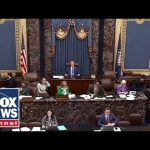
In the early hours of a recent morning, the Senate passed a bill that funds the Transportation Security Administration (TSA) and most of the Department of Homeland Security (DHS). However, that’s where the good news tends to stop, as the legislation notably excludes funding for Immigration and Customs Enforcement (ICE) and Border Patrol. While many might have been asleep at 2 a.m., the Senate was working hard—proving once again that political actions do not take a snooze button.
As the bill now makes its way to the House for a vote, it is clear that tensions are running high. The Senate’s decision has drawn ire from some who believe that addressing TSA funding without supporting border security is like building a house without a foundation. Supporters of the TSA funding argue that the critical nature of airport security requires immediate action, especially with TSA officers facing a staggering 40 days without pay. Some places, like JFK and BWI, reported up to a 29% call-out rate among security agents, sending travelers into lines that resembled the modern day equivalent of a slow march for a quest.
In an unexpected twist, President Trump decided to intervene with an executive order directing DHS to fund TSA while lawmakers work through their disagreements. He likens this to his previous actions during the government shutdown when he ensured troops were paid despite the chaos in Congress. Trump’s order has been seen by many as a practical solution to address an urgent issue, effectively saying “enough is enough” to the ongoing impasse in Congress. However, this has also brought forth a political tug-of-war where Democrats firmly stated they will not support what they characterize as unchecked funding for ICE and Border Patrol.
A backdrop of past threats and ongoing security concerns only adds fuel to the fire. The harmful effects of the prolonged funding debate become even clearer when recalling the days following September 11, where security was key. Critics note that funding disputes in Congress play dangerously with the nation’s safety. As a result, some are left questioning whether it is time to consider private security as a solution to the escalating issues surrounding TSA.
With the House vote looming, uncertainty remains. Some speculate that the House may eventually go along with the Senate’s decision to fund TSA, though many express skepticism. Democrats are plotting the next move, hoping to leverage the situation without handing over a “blank check” for an agency they argue has overstepped its bounds. On the other hand, Republicans see the need for keeping TSA operational as a no-fail mission essential to public safety.
In summary, while the Senate’s nocturnal maneuvering has shed light on the urgency surrounding TSA funding, it has simultaneously highlighted a fractured political landscape. The call for cooperation rings loud, but both sides are locked in their respective trenches, showing little sign of moving forward. As the House prepares to cast its vote, Americans can only hope that their voices are being heard over the chaos of political tug-of-war. After all, getting through airport security shouldn’t feel like a cross-country expedition.