Staff Reports
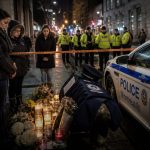
This week’s shooting outside a Montreal Hilton hotel shattered a long-standing calm: a gunman opened fire, killing a Montreal police officer, a civilian, and then himself. The slain officer — Constable Mohamed Lamine Benredouane — is the first SPVM officer killed in the line of duty in 24 years. The facts are grim; the questions about motive, online radicalization, and public safety are only getting louder.
The attack and the victims
Police say a man with a long gun opened fire near the hotel in Côte‑des‑Neiges, touching off an exchange that left three dead and at least one other officer hurt. The civilian victim has been identified as Michael (Michel) Moshe Mizrahi, and Montreal Police Chief Fady Dagher called the day “a very, very sad day” and “a nightmare.” Emergency alerts and shelter-in-place orders briefly froze parts of the city while investigators worked the scene.
Manifesto, motive and the online echo chamber
Law‑enforcement sources report a lengthy document was recovered at the scene and that investigators see links to the so‑called “incel” subculture — a violent, misogynistic online movement that has inspired real attacks before. The suspect was identified by the coroner as Seth Scott Hatfield of Lethbridge, Alberta. That alleged manifesto’s exact content and motive are still under review, and officials warn about premature speculation — which is sensible, if only the internet would cooperate.
Why this matters beyond the headlines
We can’t shrug and call this a random act. Whether the attack is ultimately labeled terrorism, a criminal act or something in between, it shows how poisonous online radicalization can spill into real life. Police watchdogs — the Bureau des enquêtes indépendantes (BEI) — will examine the use of force while provincial and federal agencies probe the wider threat. The copycat risk is real; so is the need for better tools to spot and stop violent radicalization before it reaches a hotel lobby.
Policy lessons: protection, prevention, accountability
Constable Benredouane and Mr. Mizrahi deserve more than platitudes. Montreal and provincial leaders, including Mayor Soraya Martinez Ferrada and Minister of Domestic Security Ian Lafrenière, must push for concrete action: stronger support for police on the street, clearer channels to remove violent manifestos from the feed of vulnerable people, and better mental‑health and de‑radicalization programs. If political leaders prefer posturing to prevention, expect more headlines like this — and more funerals in uniform.
This was a tragedy that exposed weak spots: a promising life cut short, a city shaken, and an online culture that can breed violence across provincial lines. The facts are still coming in, and officials must be allowed to do their work. Meanwhile, citizens and policymakers should stop treating prevention as optional. Montreal’s loss is a warning sign — not just for that city, but for any community that thinks it’s immune from the dark side of the internet.