Staff Reports
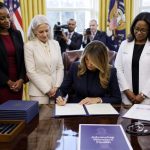
President Donald Trump and First Lady Melania Trump staged a Rose Garden signing that looks good on camera and promises to refocus federal attention on women’s health. The executive order creates a Women’s Health Division at the National Institutes of Health and a White House Women’s Health Task Force — a neat bit of government architecture that will be judged on whether it actually helps women, not on how it photographs.
What the order actually does
The text orders HHS and the NIH director to stand up a Women’s Health Division inside an appropriate NIH institute or center within 90 days and creates a White House Women’s Health Task Force co‑chaired by White House Chief of Staff Susie Wiles and HHS Secretary Robert F. Kennedy Jr. It also rescinds certain prior-administration initiatives so this administration can reframe federal strategy around maternal health, mental health, endometriosis and other conditions the White House says have been understudied. Importantly, the executive order sets structure and deadlines — it does not include a line-item appropriation. Agencies are being told to report and coordinate; Congress will still control the purse strings.
That funding gap isn’t a bureaucratic footnote. For ordinary women facing years-long diagnostic delays for conditions like endometriosis, or for new mothers in communities where maternal mortality is rising, structure without money can mean slow change. If NIH researchers are told to pivot but don’t get extra lab spots, clinical trials, or grant dollars, people won’t feel this on their bodies — they’ll feel no change at all.
Who’s running the show — and why that matters
Melania Trump put herself front and center, pitching this as her initiative to “change the reality of women’s health,” while President Trump called it “historic” and asked, “Who the hell wouldn’t have a women’s health division?” The choice of Susie Wiles and Secretary Robert F. Kennedy Jr. to lead the effort makes the politics clear: this is a White House priority, but it’s also going to draw skeptical eyes from the scientific community because of controversies around HHS leadership. That skepticism matters; researchers and medical societies will want to see peers and independent experts at the table, not just political appointees calling the shots.
Politics, timing and the hard work ahead
The Rose Garden ceremony came with all the pageantry — a planned photo op a few weeks before a major political moment — and the White House framed it as rapid action. But the next steps are the ones that will decide whether this is policy or theater: who sits on the task force, whether NIH’s new division gets real funding, and if Congress backs appropriations. Watch for how quickly the White House names members, how transparent the NIH planning is, and whether big medical groups like ACOG or the AMA endorse the approach or push back.
Promises are easy in the Rose Garden. Results require money, expertise and patience, and those are things this administration will either deliver or dodge. Will this be a meaningful restructuring that trims the research gap and speeds better treatment, or just another headline engineered to burnish credibility before voters head to the polls?